



7 Essentials for Your Hybrid Meeting Technology
We’ve all been there: stuck in a hybrid meeting where remote team members are just silent squares on a screen. The real conversation happens in the physical room, and anyone dialing in is left feeling like an afterthought. This isn't just awkward; it's a barrier to true collaboration. The good news is that this is a solvable problem. Creating an inclusive and effective meeting experience for everyone, regardless of their location, comes down to two things: clear ground rules and the right hybrid meeting technology. This guide breaks down the essential hybrid meeting equipment you need to ensure every voice is heard, loud and clear.
You're not alone in wondering that. In fact, Daniel Durrans asked that very question: “I wonder if a pro tip for hybrid office environments is: Don’t have hybrid meetings?”
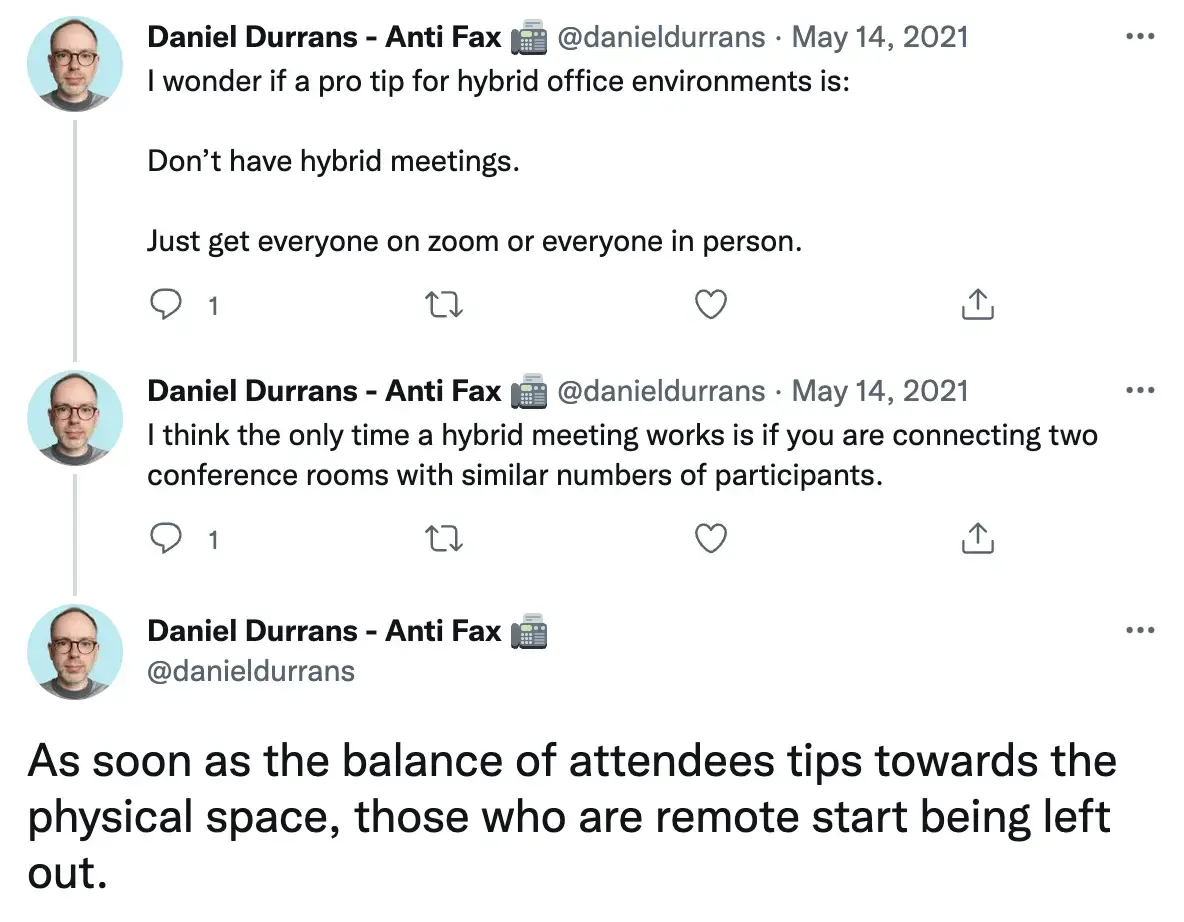
“As soon as the balance of attendees tips towards the physical space, those who are remote start being left out,” he adds.
While many people, like Durrans, think hybrid meetings don’t work, we’ve found that hybrid meetings can be a success. But only if you actively make them inclusive.
Don’t wait for your employees to tell you they feel left out and disengaged. Make your hybrid meetings more inclusive – and make sure you have all the right tech to make them work.
So, What Exactly Is a Hybrid Meeting?
The jury is still out on hybrid meetings. Some, like Durrans, believe meetings should be entirely in person or entirely remote, while others see hybrid meetings as a definite improvement of all-remote meetings.
If you’d rather avoid hybrid setups, that’s probably because you’ve experienced some of these common issues:
- One-sided conversations where meetings feel like webinars (at best)
- Few chances for remote participants to chime in with questions or ideas
- General confusion and awkwardness – especially if not all tech is working properly (Who should speak now? Is my audio lagging or is it their microphone?)
While hybrid meetings have their shortcomings, they’re a must for hybrid work environments. Plus, they give team members the flexibility to set their work schedules, whether they’re in the office or working from home.
The recipe for successful hybrid meetings? It comes down to two things:
- All participants are able to see and hear each other clearly
- All remote and in-person attendees are able to participate equally
Each of these aspects requires good planning and strong leadership skills to get them right – plus, of course, the right tech.
The Hybrid Meeting by the Numbers
Hybrid meetings are more than just a trend; they're a fundamental part of how modern businesses stay connected. When you consider that poor communication costs US businesses a staggering 2 trillion dollars each year, it’s clear why getting them right is so important. The good news is that employees are on board. During the pandemic, 64% of remote workers said they actually preferred hybrid video calls. This tells us that when the technology and structure are in place, hybrid meetings can be a powerful tool for collaboration, not a source of frustration.
The Benefits of Getting Hybrid Meetings Right
When you nail the hybrid meeting format, the benefits extend far beyond just having a productive conversation. It creates a more equitable and engaging environment where every voice, whether from the conference room or a home office, is heard equally. This sense of inclusion is vital for team morale and innovation. It shows your employees that you value their contributions, regardless of their physical location. The key is to be intentional about it. This means setting clear ground rules, investing in the right technology, and fostering a culture of mutual respect among all participants.
Successfully running these meetings also requires a bit of planning. Knowing who will be in the office versus who will be remote helps you prepare the space and the agenda accordingly. Using a hybrid work software can give you that visibility, making it easier to book the right-sized room and ensure the tech is ready to go. When everyone feels seen, heard, and prepared, you’ll notice a real difference in collaboration, creativity, and overall team cohesion. It transforms the meeting from a logistical challenge into a genuine opportunity for connection and progress.
Cost and Environmental Savings
One of the most immediate and tangible benefits of hybrid meetings is the reduction in travel. When team members don't have to commute to the office or fly across the country for a one-hour meeting, the company saves a significant amount on travel expenses, accommodation, and meals. But the savings aren't just for the business. Employees also save money and time on their daily commutes. According to Dropbox, this reduction in travel doesn't just help the bottom line; it also helps the environment by cutting down on carbon emissions, making hybrid meetings a more sustainable choice.
Improved Accessibility and Inclusion
Hybrid meetings open the door to a more diverse and inclusive workforce. They provide the flexibility needed for working parents, caregivers, and individuals with health conditions or disabilities to fully participate without the strain of a daily commute. This model also breaks down geographical barriers, allowing you to hire the best talent from anywhere in the world. Much like how organizations can attract new members from distant locations with a hybrid option, your company can build a stronger, more diverse team by embracing the same flexibility. It ensures that opportunity isn't limited by proximity.
A Glimpse into the Future of Meetings
The technology that powers hybrid meetings is constantly evolving, and the future looks even more seamless. We're moving toward a world with AI-powered assistants that can transcribe conversations, summarize key points, and assign action items in real time. Imagine virtual and augmented reality (VR/AR) making remote participants feel as if they’re sitting right there in the room, able to read body language and engage more naturally. As smart meeting rooms become more common, spaces will automatically adjust lighting, sound, and camera angles to create the perfect environment, ensuring the tech fades into the background so your team can focus on what truly matters: collaboration.
Your Essential Hybrid Meeting Technology Checklist
The setup for a remote meeting is simple – everyone logs in from their computer with their own mic and speakers. However, hybrid meetings require a more technical setup on the host’s end to ensure that in-room and virtual participants can clearly see and hear each other.
Let’s first understand the basic setup of a hybrid meeting, and then look at each component.
First Things First: The Absolute Essentials
Remote participants log into a hybrid meeting in the same way they would in a fully remote meeting: They open the meeting link on their device and use their own camera, mics, and headphones.
In-room participants need to use one device (a computer, tablet, or phone) to log into the meeting. The rest of the equipment will depend on the meeting’s size.
If it’s a small group (for example, of three to four people in the room), a laptop webcam, speakers, and microphone should be enough for everyone to see and hear each other clearly.
For a larger group, you’ll need extra equipment:
- One or more external cameras to capture all participants
- A computer and a large screen, so in-room participants can see all virtual attendees and presentations or shared screens
- An external microphone to pick up the voices of everyone in the room
- External speakers, so that all team members who are present in-person can hear remote participants well
Seamless Scheduling for Rooms and People
If you’re hosting a hybrid meeting with more than three in-person participants, you’ll probably need to book a meeting room and make sure everyone is at the right location at the right time.
How do you do that? With the right software.
Our Pick for Easy Booking: Officely
With Officely, you can quickly tame the usual hybrid meeting chaos, as it enables you to:
- Book desks or conference rooms directly from Slack or MS Teams
- Share meeting information with everyone (again, in Slack or Teams, without asking them to log into a different tool)
- Book equipment
- Check team members’ schedules and where everyone is working from to estimate attendance and plan for the right space and tech
- Ensure you’re able to make full use of your workspace
For hybrid offices, room or desk booking is a must for hosts, especially if you don’t want to be stranded with no desk and no equipment 10 minutes before your meeting starts.
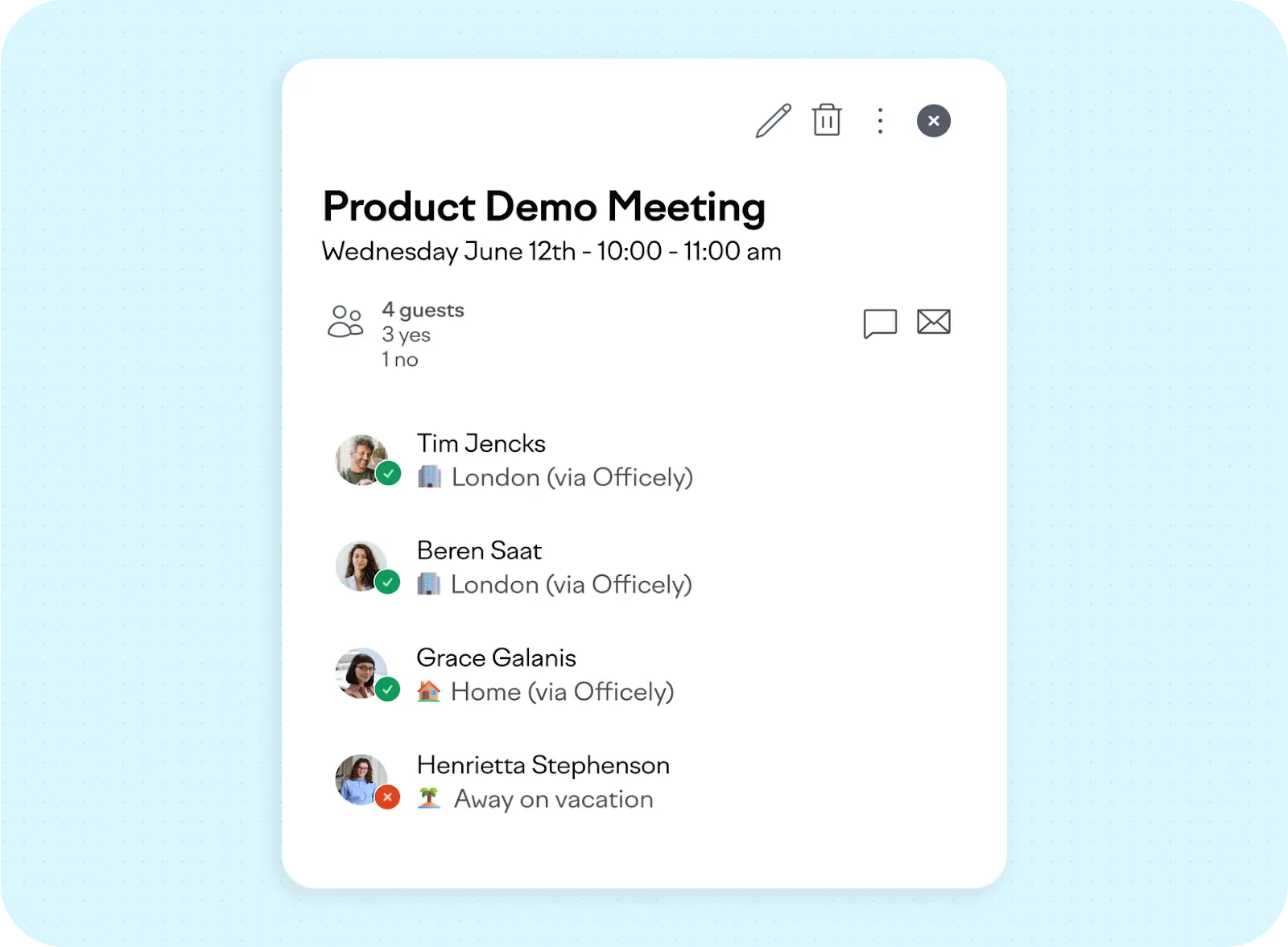
Officely makes it easy to organize effective hybrid meetings and see where everyone will be joining from
Usually, meeting hosts, facilitators, or office managers are in charge of all that – or they might need to work together to plan the meeting. Officely syncs all data in real time, so collaboration is very easy.
And, if you want to know more about office management in flexible workspaces, check out Officely’s New Office Management Handbook, which will help you create a hybrid office that helps everyone thrive and do their best work – including during hybrid meetings.
Can Everyone Hear Me? Nailing Your Audio Setup
Since the goal is for everyone to have the same meeting experience – with clear sound and the ability to participate – make sure that remote team members are able to hear everyone in the room, not just the meeting host.
Most conference rooms are equipped with microphones to pick up voices even when people are seated at a distance. If so, you don’t need extra ones. If not, you could pass around a hand-held mic.
Tips for Preventing Echoes and Feedback
Nothing derails a hybrid meeting faster than that piercing screech of audio feedback or a distracting echo. These issues usually happen when a speaker’s sound is picked up by a microphone in the same room and then played back through the speaker again, creating a frustrating loop. The simplest fix is to enforce a strict one-mic, one-speaker rule per room. Before the meeting starts, make sure every in-person attendee has muted the microphone and speakers on their personal laptops. The meeting should run through a single, dedicated device connected to the room’s main audio system to prevent echoes and keep the audio clean.
Remember, people will forgive grainy video, but they won’t tolerate bad audio. A laptop’s built-in microphone is designed for one person, not a whole room. To ensure remote participants can hear everyone clearly, not just the person sitting closest to the computer, you need the right equipment. Investing in good microphones, like omnidirectional or boundary mics, is a game-changer. These are designed to capture sound from multiple directions, making conversations feel more natural and inclusive for those joining from home. This small investment makes a huge difference in the quality of your hybrid collaboration.
For remote participants, a good pair of headphones is essential. Noise-canceling headsets are particularly helpful because they block out background distractions, allowing remote team members to stay focused on the conversation. Using headphones also prevents their computer’s speakers from feeding sound back into their own microphone, which is another common cause of echoes. On the other side of the screen, make sure your in-person team can clearly hear remote attendees. If a laptop’s volume isn’t cutting it for the whole room, connect a bigger speaker to ensure no one misses a word.
For Crystal-Clear Audio: Jabra Speak
If you often hold hybrid meetings, it could be a good idea to invest in a wireless, omnidirectional recorder-speaker combo like Jabra Speak, placed close to all participants. Models you should consider are Jabra Speak 750, 510, or 710.
All the Jabra portable speakerphones have excellent audio and are super easy to use. They’re best for small to medium-sized meeting rooms and can capture voices from all directions, even if some people are speaking quietly. All those devices are compact and wireless; you can connect them to your setup via Bluetooth or USB.
The Jabra Speak 750 has full duplex audio, allowing participants to speak and hear at the same time, which helps have a more natural conversation. (At last!)
Getting Your Video Setup Just Right
A single laptop webcam will probably not be enough to capture the room and all participants – plus, the image quality is usually not great. So, you’ll probably want to get an external camera or two, or use a separate computer connected as a “participant” in the meeting (if so, make sure to mute it!).
Depending on the meeting and the number of people, you could show multiple angles of the room, along with a close-up view of the presenter(s).
For in-room participants to clearly see remote attendees and anything that they need to share (presentations, screens, and so on), you’ll need to connect your laptop to a large external monitor like a TV or a projection screen via HDMI.
Specialized Cameras for Every Angle
To make remote attendees feel like they're actually in the room, you need a camera that does more than just sit on a laptop. A dedicated conference camera can capture the entire space and intelligently focus on who’s speaking. The Meeting Owl Pro is a great example, offering a 360-degree view that automatically shifts to the current speaker. This dynamic perspective is much more engaging than a static, wide shot where remote viewers can't make out facial expressions. If a specialized camera isn't in the budget, you can get creative by setting up a separate computer or tablet on a tripod to act as a second camera, giving everyone a different perspective of the room.
Keeping Your Video Steady and Professional
A shaky, poorly positioned camera can instantly make a meeting feel unprofessional. If you’re using an external webcam, secure it on a tripod to keep the video feed stable and consistent. It's also important to position the camera at eye level with the people in the room; looking up or down at a camera feels awkward and disconnected for remote viewers. Before the meeting starts, take a moment to frame the shot properly. Make sure everyone who is physically present is visible without being too far away. The goal is to create an inclusive view that allows remote team members to see who is speaking and read the room’s body language, making the conversation feel more natural for everyone.
The Importance of Good Lighting
Even the best camera can't overcome bad lighting. Without it, your video feed will look grainy and unprofessional, making it hard for remote participants to see facial expressions and non-verbal cues. These visual details are essential for effective communication. Whenever possible, use natural light by positioning your in-room setup to face a window. Be sure to avoid sitting with a bright window or light source behind you, as this will cast you in shadow. If your meeting room doesn't have much natural light, a simple ring light or a well-placed lamp can make a huge difference by illuminating the faces of your in-person team so everyone is seen clearly.
For a 360° View: The Meeting Owl
If your budget allows it, you could invest in a conference camera like the Meeting Owl, which has a built-in microphone to capture the voices and faces of everyone in the room.
Meeting Owl is a smart 360-degree designed specifically for hybrid meetings, and that captures the entire room and all participants.

Meeting Owls in action (Image source)
It automatically focuses on speakers by zooming in and shifts the focus whenever someone else is speaking. This helps remote participants follow the conversation easily, without struggling to figure out who’s talking. The device’s microphone is built to pick up voices from the entire meeting space.
And, given that it’s compatible with popular video conferencing platforms like Zoom, Microsoft Teams, or Google Meet, you can simply plug it in and get going.
Tools to Keep Everyone on the Same Page
In hybrid meetings, collaboration tooling simply refers to the digital tools that enable everyone to work together efficiently: Ask questions, add comments, make notes, give feedback, and so on. This helps you ensure everyone can contribute fully and be in sync with others.
Think shared document collaboration tools, digital whiteboards, chat and instant messaging tools, file sharing, and more.
Interactive Displays for Real-Time Collaboration
Remember the days of crowding around a physical whiteboard? That doesn't quite work when half your team is remote. Interactive displays, like the Microsoft Surface Hub, are the solution. Think of them as giant, collaborative touchscreens for your meeting room. They allow everyone, whether they’re in the office or working from home, to draw, write, and interact with the same digital canvas in real time. This technology is a game-changer for brainstorming sessions and workshops, as it ensures remote participants can contribute ideas just as easily as those physically present. It effectively bridges the collaboration gap, making meetings more dynamic and inclusive for the entire team.
Wireless Presentation Tools
Nothing kills the momentum of a meeting faster than someone fumbling with cables and adapters to share their screen. Wireless presentation systems, like Barco ClickShare, eliminate this common headache. These tools allow any participant in the room to instantly project their laptop screen onto the main display without plugging in a single wire. This makes for seamless transitions between presenters and keeps the meeting flowing smoothly. By removing the technical friction of connecting devices, you create a more professional and efficient environment where the focus stays on the content, not on whether the HDMI cable is working.
Keep the Conversation Flowing with Slack
Slack is a great choice for collaboration during meetings, as it’ll help teams prepare, set clear expectations, share agendas, docs, and meeting notes, and follow up. This helps make each call more to the point; because, let’s be honest, nobody likes being stuck in endless calls with no clear agenda or goals.
When you have multiple in-person participants in the same physical room, it might be impractical for everyone to use their own devices to use Slack; in this case, the meeting host might need to open the relevant channel on their computer and keep an eye on it to see if anyone has extra questions or comments. For this, they don’t need to display it on the shared screen. You can also use built-in polls to make decisions together in real time.
However, if you’re already using other platforms like Microsoft Teams, you can obviously stick to what works for your team – no need to switch software.
Ensuring a Stable and Secure Connection
All the high-tech cameras and microphones we've talked about are only as good as the internet connection that powers them. A choppy, unreliable connection can derail even the most well-planned meeting, leaving remote attendees frustrated and in-person participants talking to a frozen screen. Getting your connection right is the foundational step to making hybrid meetings work.
Internet Connectivity Best Practices
A strong, stable internet connection is absolutely non-negotiable for quality video and audio. While good WiFi is a start, it can be prone to interference. For the most important devices in your meeting room—like the main computer and camera—a wired Ethernet connection is your best bet for a rock-solid, reliable stream. This simple step can eliminate a lot of the lag and choppiness that plagues hybrid calls. If you're dealing with weak signals in parts of the office, network extenders can help ensure consistent coverage. Encourage remote team members to also check their connection speed before important meetings to prevent disruptions on their end.
Network Management and Security
Beyond just speed, the security of your network is critical. With team members joining from different locations, protecting sensitive company information during hybrid meetings is more important than ever. Make sure your office network is secure and password-protected, and that all your video conferencing software is kept up-to-date to patch any vulnerabilities. This also means encouraging remote employees to follow best practices for network security at home. A secure and well-managed network not only protects your data but also ensures that all your meeting technology can communicate effectively, providing a seamless experience for everyone involved.
Bringing It All Together with an Event Platform
Now, if you need to host a very large meeting or a webinar, the tech solutions we listed above probably won’t cut it; in this case, you might need to invest in a hybrid event platform. This will typically be an all-in-one solution for hosting large events where some of your participants are joining in remotely, while others are with you in the same conference room.
Those are definitely the big guns of hybrid meetings and in most cases, you won’t need them – but if you do, make sure they have the right features for you, such as deep analytics, attendee tracking, the ability to add your branding, and so on.
Our Top Platform for Hybrid Events: Bizzabo
If you need to organize large hybrid events, Bizzabo is a great option. It offers customization, data analytics, and branding to help you set up everything and track performance.
With it, you can add your branding at all touch points, such as registration pages, email marketing, landing pages, and the event itself. You can track attendance for both in-person and virtual participants easily, and also use interactive features like chat, polls, and Q&A to make sure everyone can participate.
Planning for a Flawless Hybrid Meeting
Having the right technology is a great start, but it’s only half the equation for a successful hybrid meeting. The other half is planning. A little bit of forethought can make the difference between a clunky, frustrating call and a smooth, productive session where everyone feels included. By thinking through the logistics before you hit 'start,' you can address potential issues and create an environment where both in-person and remote attendees can contribute equally. Here’s how to prepare for a flawless meeting every time.
Assign Key Roles Before You Start
To keep your meeting on track, it’s helpful to assign a couple of key roles beforehand. Typically, a meeting host or office manager is responsible for the logistics, but you might also want a dedicated facilitator. The host handles the technical side of things—setting up the call, managing screen sharing, and troubleshooting any glitches. The facilitator, on the other hand, focuses on the human element. Their job is to keep an eye on the remote attendees, make sure their questions are heard, and actively bring them into the conversation. This prevents remote team members from feeling like they’re just watching a webinar and ensures everyone has a chance to participate.
Preparation is Everything: Test Your Tech
Never assume the technology will just work. A few minutes of preparation can save you a lot of headaches later. Before your meeting, do a full tech run-through in the actual room you'll be using. Check that the camera captures everyone in the room, the microphone picks up voices clearly from all corners, and the speakers are loud enough for everyone to hear remote participants. Test the screen sharing function and make sure your internet connection is stable. This is especially important for ensuring your remote and in-person attendees have an equitable experience, as nothing alienates remote workers faster than a meeting derailed by technical difficulties they can't help solve.
Setting Up the Physical Room
How you set up the physical meeting space has a huge impact on your remote attendees' experience. For a small meeting with just a few people in the room, a single laptop with a good webcam and microphone might be enough. But for larger groups, you’ll need to upgrade your setup. Use an external, wide-angle camera to capture the entire room, and connect to a large screen so in-person attendees can clearly see their remote colleagues. An external microphone and speakers are also essential to ensure conversations flow naturally in both directions. Using a meeting room booking software can help you reserve a space that already has the right equipment, taking the guesswork out of your setup.
Always Have a Backup Plan
Even with the best preparation, technology can sometimes fail. That’s why having a backup plan is non-negotiable. What will you do if the conference room Wi-Fi drops? Have a mobile hotspot ready to go. What if the main camera stops working? Designate a colleague to join from their laptop as a secondary video source. It’s also a good idea to share a phone number for a dial-in option in the meeting invite. Being prepared for potential issues shows respect for everyone’s time and ensures that a minor technical hiccup doesn’t bring the entire meeting to a halt. It keeps the momentum going and reinforces a professional, organized atmosphere.
Simple Ways to Make Hybrid Meetings More Inclusive
Let’s now set some ground rules for making hybrid meetings feel inclusive and natural, rather than like the painful and uncomfortable experience everyone expects them to be.
First, Ask: Is This Meeting Really Necessary?
Live meetings aren't the only way to communicate. In fact, many employees find meetings disruptive; we all sometimes feel that this meeting could’ve been an email.
Turning an unnecessary meeting into an email, Slack message, or pre-recorded video could save your team hours: 30-60 minutes of actual meeting time plus the hours they would have spent prepping for the meeting, context switching, and refocusing after the meeting.
But when is a meeting worth your time? We designed a flow chart to help you out.
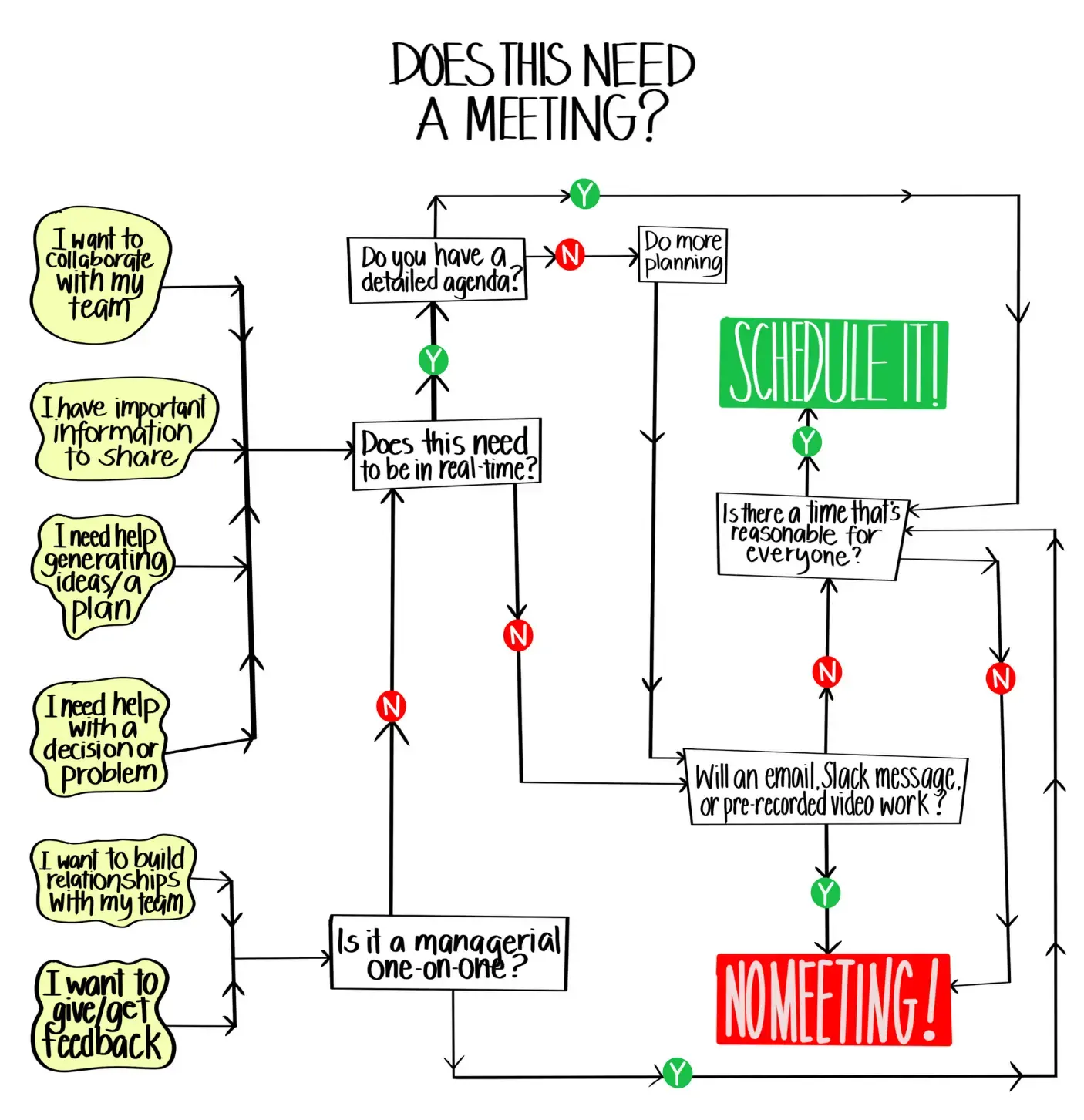
Take advantage of asynchronous collaboration tools when possible.
The bottom line: lean on asynchronous communication when you can:
- Use Slack and Notion for team channels and private messages
- Use Loom or Soapbox to record videos and screencasts to send to your team
- Use 360Learning and WorkRamp for on-demand training
- Use email for company-wide announcements that don’t need responses
That doesn't mean you should never schedule real-time meetings, however. Live video calls are great for sensitive topics, management-type meetings, and problems you've tried (and failed) to solve async.
Set Some Ground Rules for Better Meetings
When you have one team in the same room, it’s easy to talk over each other, leave out the people on screens, or miss important details.
Which is why 43% of remote employees felt left out during meetings. And yet, just 27% of companies set ground rules to make them feel heard.
Rules make both parties stay aware of each other, keeping meetings inclusive.
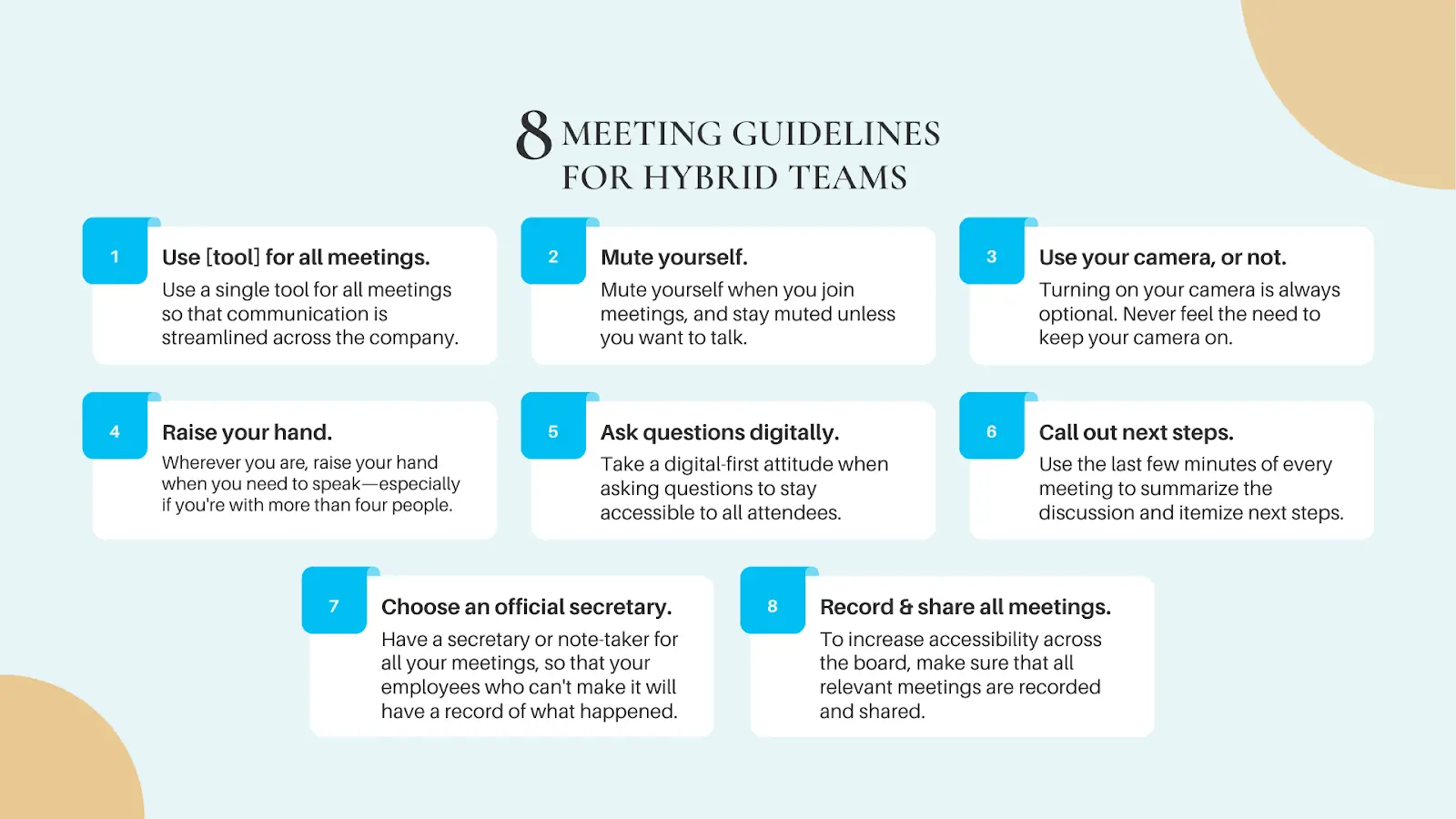
Our downloadable hybrid meeting guidelines have eight rules every team needs to have.
Different ground rules work for different companies, so you’ll definitely need to customize yours to fit your team.
Essential Etiquette for All Participants
Whether you're joining from the office or your home, everyone plays a part in making the meeting a success. Before the call starts, do a quick tech check—especially your audio. Good audio is crucial for clear communication. During the meeting, be mindful of the conversation flow. It's easy for in-person attendees to dominate the discussion, so make a conscious effort to pause and create space for remote colleagues to speak. If you're remote, don't hesitate to use the "raise hand" feature or the chat to jump in. Following a few simple ground rules ensures that every voice is heard and valued, preventing the common issue where remote team members feel like they're just watching a webinar instead of actively participating.
Write a Meeting Invite People Will Actually Read
Tell your attendees what the meeting is about so they can come prepared, ensuring that your meeting stays on topic, achieves its goals, and ends on time.
All of your meeting invites should have these five elements:
- The topic of your meeting in the title
- A quick summary of what your meeting is about
- What your attendees need to prepare beforehand (e.g., ideas, notes, etc.)
- Expected meeting outcomes
- Meeting time and link
Find a Time That Works for Everyone
Like the flow chart says: If you can't find a reasonable time that works for everyone, then default to asynchronous communication.
Many remote employees fear that having an in-office counterpart will mean they’ll be left out and left behind. Continuously leaving out your remote employees because they're in “inconvenient timezones” compared to your in-office employees validates those fears.
Schedule meetings that work for everyone by using tools like the World Time Buddy:
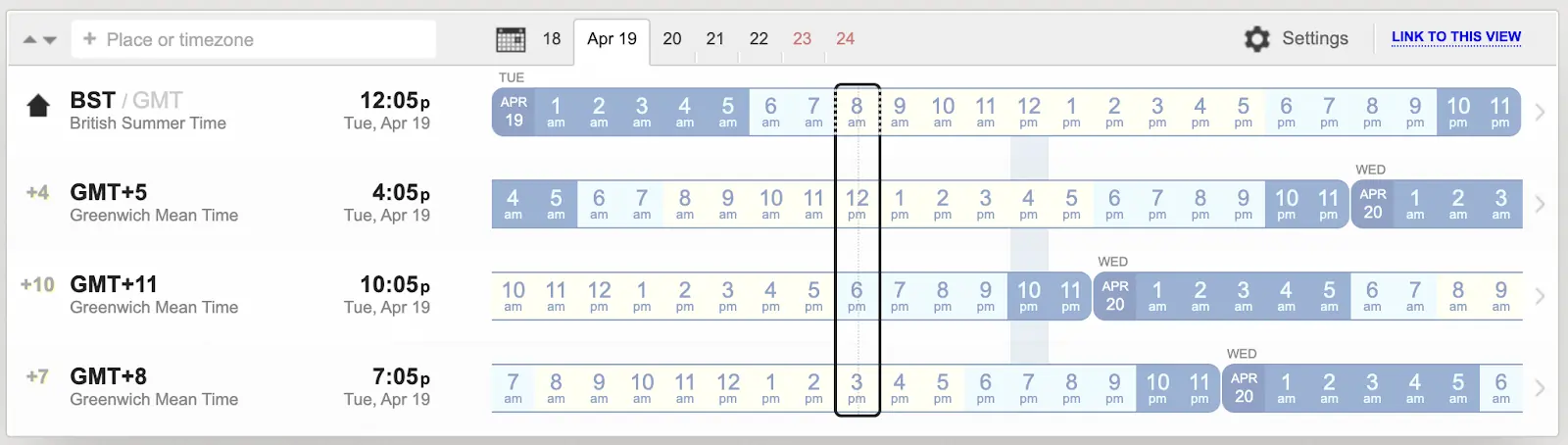
World Time Buddy makes it easy to find the best meeting time for distributed teams
Also use flex office software so you can easily book conference rooms in the office whenever needed.
Think Digital-First to Include Everyone
Your remote team and in-office team log into your meeting differently.
Remote employees follow a meeting link and enter the virtual room – one person per laptop. Your in-office team will probably have three or more people on one device.
You need to have a digital-first setup that gives both your remote workers and your in-office team similar meeting experiences.
Start with choosing your meeting application. If you want to use Zoom, then make sure your team knows that all of your meetings need to have a Zoom link, not a Google Meet one. Next, test all your technology beforehand, including your mic, your presentation, and your meeting app’s screen share feature. And, lastly, ensure has received the meeting agenda and knows what the meeting is about.
Always Record and Share Your Notes
Make sure you have a video recording of all meetings, along with detailed notes, and a quick summary that highlights important points and next steps. You can use an AI tool for that, like Otter, Fathom, or Fireflies.
AI meeting assistants automatically “join” your meetings, transcribe the conversation, and send the notes to whoever you want to send them to. You can customize meeting notes settings to have them sent only to you, your teammates, or all meeting participants.
A Little Prep Goes a Long Way
If you focus on making your hybrid meeting experience a human experience, then you won't have the problem of team members feeling left out.
However, hybrid meetings do require more preparation and planning to get right than your standard in-person or remote meeting.
That preparation comes in the form of using the best tools for the job, including the right workspace management software (like Officely) to plan where and when your meetings will take place, know who’ll be able to participate in person, and ensure you have the right equipment at hand.
For more ideas on how to better organize hybrid workspaces and meetings, check out our comprehensive guide to office management in flexible workspaces, an eBook we’ve created to help office managers better tackle the challenges of hybrid work.
And, if you’re ready to provide your team with a better and simpler way to book meeting rooms, desks, and equipment in a hybrid office, book a demo to see how Officely can help with all that – and more!
Frequently Asked Questions
My budget is tight. What's the one piece of tech I should invest in first? If you can only upgrade one thing, focus on your audio. People are generally forgiving of a less-than-perfect video feed, but they will check out immediately if they can't hear what's going on. A good external microphone, like an omnidirectional one that can pick up sound from around the table, makes the biggest difference in ensuring remote participants feel included in the conversation.
Is all this equipment really necessary for a small team meeting? Not at all. If you just have two or three people in the office, a single laptop positioned correctly can often do the job just fine. The key is to scale your setup to the size of the group. The moment you have more people in the room and the conversation starts to feel one-sided for remote attendees, it's time to bring in an external camera and microphone to capture the whole group dynamic.
How can software like Officely help beyond just booking the room? Think of it as your pre-meeting command center. Beyond just securing a space, it gives you a clear headcount of who will be in the office and who will be remote. This visibility is crucial because it helps you decide if you need a small huddle room or a large conference room with a full tech setup. It takes the guesswork out of planning and ensures you have the right resources ready to go before the meeting even starts.
The tech is one thing, but how do I get my in-office team to remember the remote folks? This is where a dedicated facilitator can be a game-changer. Assign one person in the room the specific job of being the advocate for remote attendees. Their role is to watch the chat for questions, create pauses in the conversation for remote team members to speak, and ensure everyone on the screen is addressed directly. This simple act of assigning responsibility makes inclusivity an active part of the meeting rather than an afterthought.
What's the easiest way to fix audio problems like echoes? The most common cause of echoes is having multiple active microphones and speakers in one room. The simplest fix is to enforce a "one device" rule. Have everyone in the physical room mute their laptops and run the entire meeting's audio through a single, dedicated computer connected to the room's main microphone and speaker system. This prevents the sound from looping back on itself and creating that frustrating feedback.
Key Takeaways
- Bridge the virtual and physical gap with the right tech: A successful hybrid meeting depends on more than a single laptop. Prioritize crystal-clear audio with external microphones and ensure everyone is visible with wide-angle or 360-degree cameras to create a single, unified experience for all.
- Proactive planning prevents common frustrations: Don't wait for problems to happen during the call. Before every meeting, test your equipment in the room, assign a facilitator to advocate for remote attendees, and always have a backup plan in case of technical failures.
- Establish clear ground rules for equal participation: Level the playing field by setting clear meeting etiquette, using collaborative digital tools that everyone can access, and intentionally pausing to create space for remote participants to contribute to the conversation.


